
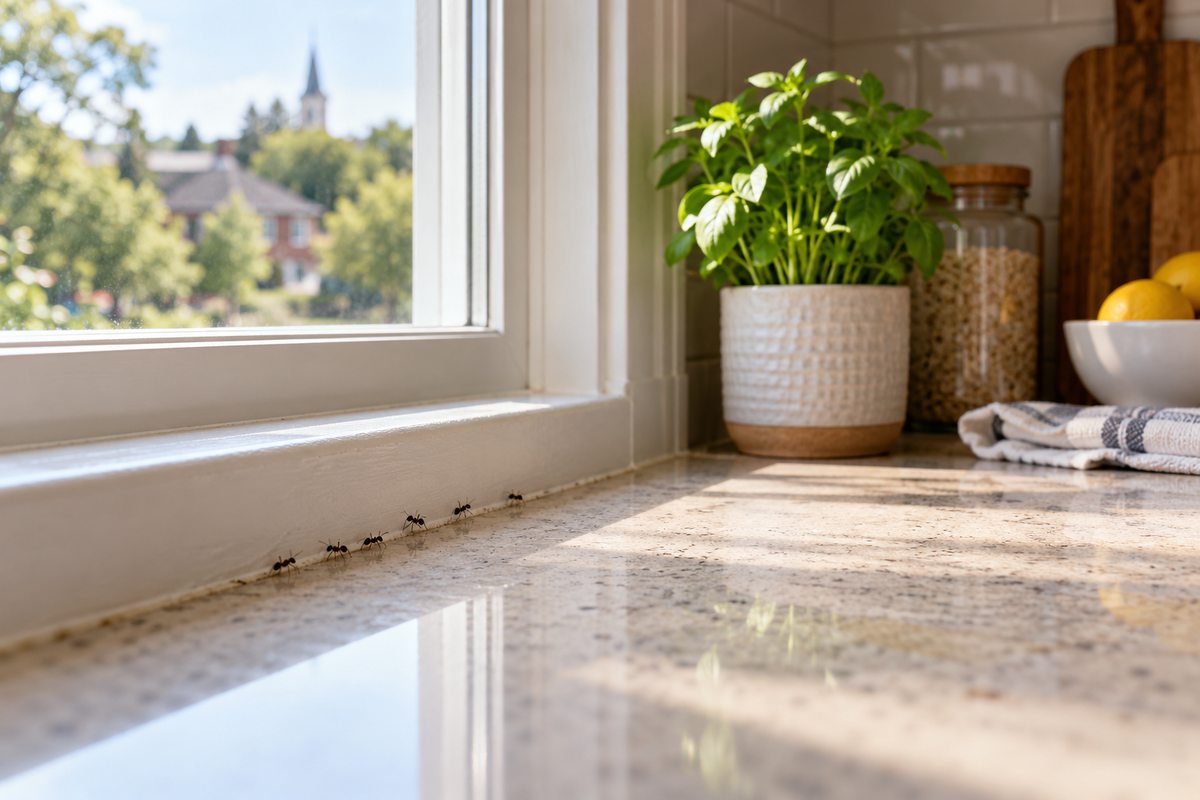
Trails near kitchens and exterior doors
Record where the activity changes from outside to inside.
Ant ControlFor pest control in Ballenger Run, explain how the concern connects to the spaces you use: a kitchen, garage, patio or private yard. We accept enquiries at qualifying 21703 addresses and discuss inspection needs before assuming that the whole property needs treatment.
Physical service address: 21703. Availability and scope confirmed when booking.
The public Ballenger Run planning material presented to Frederick County Public Schools identifies a Ballenger Creek Pike site in 21703 with attached and detached housing. It is historical planning context, not a current survey of every building or its condition.
Tell us whether your home has a side access route, a garage entrance or a rear area reached through the house. For attached homes, identify which walls or landscape strips are shared. These details determine what can be inspected without crossing another property.
Record where the activity changes from outside to inside.
Ant ControlDiscuss identification and safe access without approaching the nest.
Bee, Wasp & Hornet ControlDefine the outdoor boundary and sensitive spaces before considering treatment.
Mosquito & Tick ControlFor ants near a patio door, note whether there is a visible trail indoors and where it disappears. Activity outside does not necessarily mean there is an indoor nest. Cleaning food spills and reporting moisture are useful first steps while the insect is identified.
For a nest or repeated flying-insect traffic near a doorway, keep people and pets back. Describe the height and entry location from a safe position; do not plug a hole or disturb a nest to see what is inside. Access and identification determine the appropriate service discussion.
An exterior proposal should identify the area involved and account for gardens, play equipment, pets and shared pedestrian routes. Let us know if rear access requires someone to be home. Do not assume that an outdoor application means there are no preparation or re-entry instructions.
For indoor work, wait for the method-specific checklist before moving furnishings or washing treated surfaces. Ask what evidence to record afterward and when to report continued activity. Clear instructions make it easier to evaluate progress without disrupting the intended treatment or monitoring.
For Ballenger Run residents, a wasp visiting flowers is a different report from repeated traffic through an opening beside a doorway. Observe from a safe distance and explain the pattern. Do not approach closely to determine whether an opening contains a nest.
Maryland Extension describes social wasp nests in several settings, including ground cavities, shrubs and building voids. Nest location and insect identification influence the response. A visible hanging nest is therefore not the only possible source, and size or color alone can be misleading.
Mention whether the activity is close to a regularly used entrance or a place that can be avoided. Keep people and pets away from the suspected nest and postpone mowing or trimming immediately around it. Do not probe, block or dismantle the opening to collect evidence.
Describe the side of the property using a fixed reference, such as the front entrance or rear gate. Say whether reaching the location requires a ladder, access through a home or permission from an adjoining owner. These details help establish whether the proposed visit has the right scope.
For an attached property, a boundary can be difficult to judge from the location of insect traffic. Do not assume that an opening near your patio is entirely within your authority to alter. Provide photographs taken from your own accessible space and explain any uncertainty.
If the location cannot be safely avoided, make that clear during the enquiry and ask about appropriate availability. Do not interpret a website service listing as a promise of an immediate response. For concerning symptoms after a sting, seek medical help rather than waiting for a pest appointment.
A proposal should distinguish control of current activity from removal of accessible nest material and repair of an opening. These tasks may not all be included. Ask what can be inspected afterward and whether another trade is needed to restore a building component.
Document the original location and retain any completion instructions. If insect traffic returns, report whether it is at the same opening or a different one. That distinction gives the follow-up a useful starting point without assuming that every later wasp belongs to the original nest.
Only if that space is within the authorized scope. Identify private and common land before arranging exterior work.
No. Evidence, pest identification and access determine the proposal. Adjoining construction is a reason to discuss coordination, not to assume identical problems.
Explain the available route when booking. Access timing, pets and household precautions should be agreed before the visit.
Do not block or disturb a suspected active nest opening yourself. Keep a safe distance and request an assessment. The treatment, removal and any later building repair need to be considered in the right order.
Not by itself. Wasps also forage away from nests. Describe the behavior and any nearby nest evidence so the discussion can focus on an actual conflict rather than treating all outdoor insects as a problem.
Call with the physical address, observed signs and any access restrictions. Ask about current availability and the inspection or service that fits the concern.
Call (301) 264-9552See the 21703 coverage directory for address checks and other covered communities.
Choose the right service across the wider Ballenger Creek area.
View the local guide for Ballenger CreekClarify what a private-property booking includes before exterior work begins.
View the local guide for KingsbrookCreate an actionable rental-unit report without blaming neighboring occupants.
View the local guide for Wellington TraceCommunity sources establish location or property context, not pest prevalence, customer relationships or an endorsement.